Music therapy is an evidence-based treatment in which the music itself is the therapy.
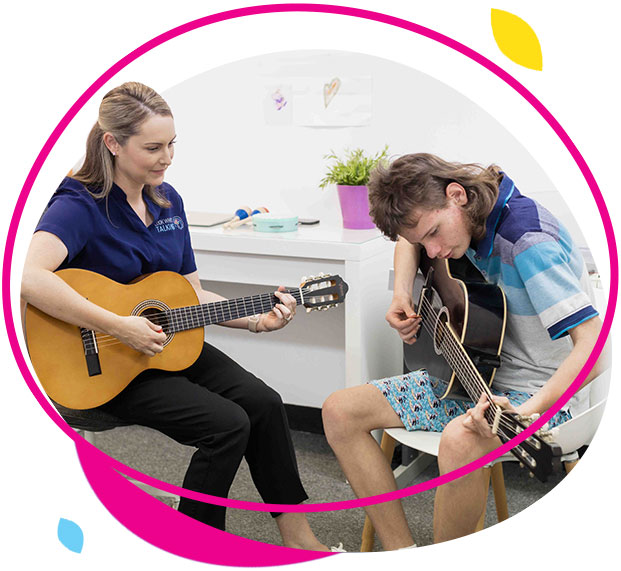
You don’t have to be a great musician to benefit from music therapy. In fact, we’re not here to teach you how to play an instrument (you need music lessons for that). We’re here to help you express yourself through music with the guidance and support of our experienced music therapist.
“Where words fail, music speaks.”
Hans Christian Andersen
What are the benefits of music therapy?
No matter how young or old you are, music therapy can help you to improve your physical and mental health.
Music therapy can improve
Mental health and wellbeing
Reduce anxiety or stress
Regulate moods and energy levels
Increase motivation
Manage anger and frustration
Manage challenging behaviour.
Speech, communication and social connection
Improve verbal and non-verbal communication
Improve physical speech function
Increase social skills & interaction
Increase independence
Give positive, new ways to deal with situations.
Body movement, coordination and physical function
Improve fine & gross motor function
Improve balance
Increase physical independence
Help regulate heart rate, breathing rate and blood pressure
Improve respiratory muscle strength and control
Improve sleep.
Memory, attention and cognitive function
Increase self-awareness
Recognise appropriate behaviour
Improve memory & attention
Improve emotional self-regulation
Improve planning and problem-solving.
Pain management
Reduce pain perception
Increase production of natural painkillers
Support faster recovery from medical procedures.
The overall result is a happier, healthier you. This just might be the most enjoyable hour of your whole week.
Music therapy can help people with a number of different conditions affecting behaviour, communication, mood or movement. It is a registered NDIS support.
Autism spectrum disorder
Attention deficit hyperactivity disorder (ADHD)
Anxiety and depression
Bipolar disorder
Obsessive-compulsive disorder (OCD)
Post-traumatic stress disorder (PTSD)
Dementia
Physical disability
Stroke rehabilitation
What does a music therapist do?
Music therapists hold a Master’s degree in the subject, which takes 2 years to complete full-time. Before that, they have either obtained a degree in music or a degree in a related health profession and demonstrated a high level of musical skill.
Almost anything can be music. Our music therapist plays several instruments including guitar, piano and violin but you can use almost anything to make music. You could:
Tap your hands on a table to create rhythm
Use your voice to make a melody
Play fast or slow, loudly or softly to express different feelings.
Individual and group therapy options
At Look Who’s Talking, you have two options for music therapy: a 1:1 appointment or a group program.